Ultradian Rhythms: What They Are, What the Science Says, and How to Use Them
Ultradian rhythms are biological cycles shorter than 24 hours. Here's what the science says about the 90-minute focus cycle and how to use it.


It's 10am and you're in flow. Words come easily, problems solve themselves, focus feels effortless. By 11:30, the sharpness fades. You're reading the same paragraph for the third time. Nothing changed in your environment. So what happened?
Your brain runs on cycles shorter than a day. These ultradian rhythms, roughly 90 to 120 minutes long, influence everything from your sleep architecture to your hormone levels to how well you can concentrate. The productivity internet has latched onto this idea with a simple prescription: work for 90 minutes, rest for 20. But the actual science is more interesting, more complicated, and more useful than that soundbite suggests.
What Are Ultradian Rhythms?
Ultradian rhythms are biological cycles that repeat more than once within a 24-hour period. The prefix "ultra" here means "beyond" (as in, beyond the frequency of a daily cycle), while "dian" comes from the Latin dies, meaning day.
They sit in a family of biological rhythms defined by their period length:
| Rhythm Type | Period | Examples |
|---|---|---|
| Circadian | ~24 hours | Sleep-wake cycle, core body temperature, melatonin release |
| Ultradian | < 24 hours | Sleep stages (~90 min), cortisol pulses (~1-2 hrs), appetite cycles |
| Infradian | > 24 hours | Menstrual cycle (~28 days), seasonal mood changes |
The most familiar ultradian rhythm is the one you cycle through every night: sleep stages. Your brain moves through light sleep, deep sleep, and REM sleep in roughly 90-minute cycles, repeating four to six times per night (1). This is well-established science with decades of polysomnographic data behind it.
But the ultradian story doesn't stop at sleep. These sub-daily rhythms show up across your biology: in hormone secretion, appetite, nasal airflow, and possibly in waking cognitive performance. That last one is where things get interesting and contested.
The Science Behind the 90-Minute Cycle
Kleitman's Basic Rest-Activity Cycle
The idea that 90-minute cycles extend into waking hours comes from Nathaniel Kleitman, the same researcher who co-discovered REM sleep. In 1963, Kleitman proposed the Basic Rest-Activity Cycle (BRAC): a roughly 90-minute oscillation in arousal and alertness that continues throughout the day, not just during sleep (2).
The hypothesis was elegant. If the brain cycles through 90-minute phases of varying arousal during sleep (which it demonstrably does), why would that cycling stop the moment you wake up? Kleitman suggested it doesn't. Instead, the same oscillation manifests as waves of higher and lower alertness, attention, and cognitive capacity during waking hours.
The Supporting Evidence
Several studies have found patterns consistent with the BRAC hypothesis. Lavie's ultrashort sleep-wake experiments in the 1980s demonstrated roughly 90-minute "sleep gates," periods when falling asleep was significantly easier, suggesting an underlying rhythm in sleepability (3). A 1995 study by Folkard and Monk detected approximately 90-100 minute cycles in EEG activity, mood, and task performance, along with slower multi-hour ultradian oscillations (4). Lavie and colleagues also found rhythmic modulations in short-term memory and information processing during extended performance tasks (5).
The Contested Evidence
Here's where intellectual honesty matters. Not all studies support a clean 90-minute cognitive rhythm. A 1995 study by Monk et al. specifically looked for a 1.5-hour rhythm in cognitive performance and didn't find one (6). The researchers tested multiple cognitive tasks over extended periods and concluded there was no clear evidence for the BRAC operating on cognitive function in the way Kleitman originally proposed.
This doesn't mean the BRAC is wrong. It means the waking manifestation of ultradian rhythms is less consistent and harder to detect than the sleep manifestation. Individual variation is large. Environmental factors (caffeine, stress, social interaction) can mask or override the underlying rhythm. And the cycle length itself may vary from person to person, ranging from 80 to 120 minutes rather than a fixed 90.
The honest summary: there's good evidence that arousal and alertness fluctuate in sub-daily cycles. There's weaker evidence that these fluctuations follow a precise 90-minute clock in everyone. The practical implication holds either way: your focus capacity is not flat across the day, and working in extended blocks without breaks ignores real biological variation.
Ultradian Rhythms Beyond Sleep
The 90-minute focus cycle gets the most attention in productivity circles, but it's actually one of the less well-documented ultradian rhythms. Your hormones tell a clearer story.
Cortisol Pulsatility
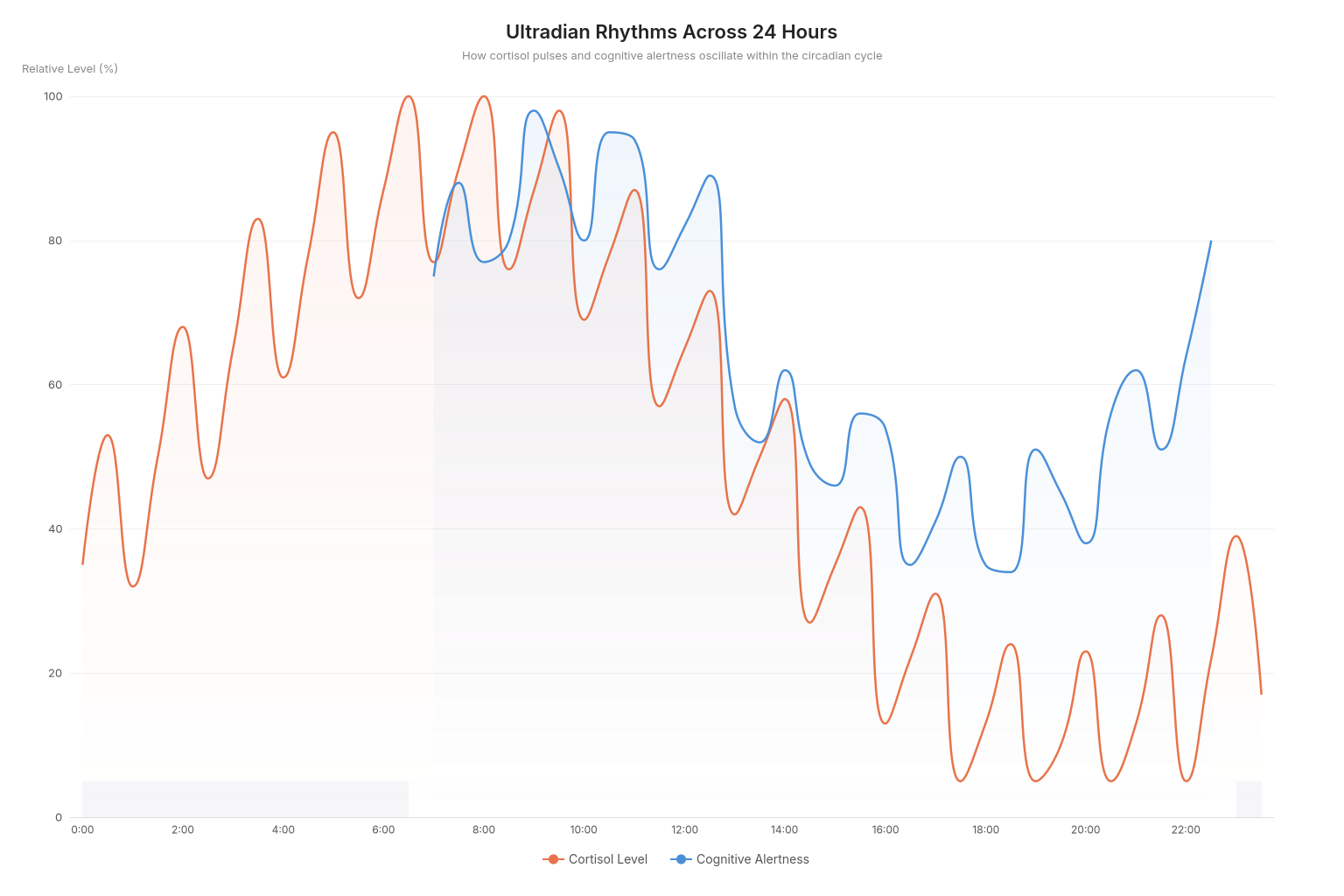
Your body doesn't release cortisol (the primary stress hormone) in a smooth curve. It pulses. Walker, Terry, and Lightman showed in 2010 that the pituitary-adrenal feedback loop generates ultradian cortisol pulses on its own, without requiring external input (7). These pulses occur roughly every 1-2 hours.
This isn't a minor biochemical detail. Stavreva et al. found in 2009 that the pulsatile pattern of cortisol release encodes a biologically distinct signal (8). Genes respond differently to pulsed cortisol than to flat, constant cortisol exposure. The rhythm itself carries information. Lightman and Conway-Campbell's 2010 review in Nature Reviews Neuroscience argued that this pulsatile activity is crucial for maintaining optimal stress responsiveness and brain function (9).
A 2024 review by Lightman et al. confirmed that the HPA axis operates as a dynamic system with combined circadian and ultradian oscillations, both of which have clinical relevance (10).
What this means practically: your stress system is rhythmic. There are windows when you're more hormonally primed for challenge and engagement, and windows when your system is in a relative trough. This aligns with the subjective experience of focus coming in waves rather than being a switch you can flip and hold.
Hemispheric Alternation
A less widely known ultradian phenomenon: your brain hemispheres appear to alternate in relative dominance. Okawa et al. documented endogenous alternation of right and left cerebral hemisphere activity with a periodicity of roughly 90-200 minutes during waking and about 100 minutes during sleep (11).
This is still an emerging area of research, and the practical implications aren't fully clear. But it adds another layer to the picture: your brain isn't running the same program continuously. It shifts modes on a sub-daily basis.
Ultradian Rhythms and Productivity
The productivity application of ultradian rhythms has been oversimplified. The standard advice goes: "Work for 90 minutes, take a 20-minute break, repeat." Some sites cite this as settled science. It isn't, but the underlying principle is sound.
What the Evidence Supports
Sustained focus beyond 90-120 minutes yields diminishing returns for most people. This finding appears across multiple research contexts. Ericsson, Krampe, and Tesch-Romer's landmark 1993 study on deliberate practice found that elite performers across fields (musicians, athletes, chess players) rarely practiced in sessions longer than 90 minutes, and they typically managed only 3-4 such sessions per day (12). The researchers weren't studying ultradian rhythms, but the pattern maps perfectly onto BRAC-length work windows.
What the Evidence Doesn't Support
A rigid 90-minute timer isn't backed by the research. Your cycle may be 80 minutes or 110 minutes. It may shift depending on the task, your arousal level, your caffeine intake, or whether you slept well. The Monk et al. (1995) negative finding is important here: if trained researchers couldn't reliably detect a 90-minute cognitive rhythm under controlled conditions, a fixed 90-minute productivity timer is unlikely to match your biology precisely (6).
The better approach is tuning into your own signals. When your focus genuinely fades (not boredom, but a real drop in processing capacity), that's your ultradian trough arriving. Take a break then, whether it's been 70 minutes or 110 minutes.
The Energy Management Connection
Ultradian rhythms are one piece of a larger energy management picture. Time blocking gives you the structure. Ultradian awareness tells you how to fill that structure: deep work during high-arousal phases, lighter tasks during troughs, and genuine rest at transition points.
This is the difference between treating your calendar as a container for tasks and treating it as a map of your cognitive capacity. The first approach fills every hour equally. The second approach recognizes that some hours are worth three times as much as others.
How to Work With Your Ultradian Rhythms
1. Track Your Energy, Not Just Your Time
For one week, note your focus quality three times per day (morning, midday, late afternoon) on a 1-5 scale. After a few days, you'll likely see a pattern: peak focus for 2-4 hours, a trough, and sometimes a second smaller peak.
2. Structure Work in Natural Blocks
Instead of forcing 90 minutes, work until your focus genuinely drops. For most people, this falls somewhere between 75 and 120 minutes. When the drop comes, stop. Don't push through it. You're fighting your biology, and biology wins.
3. Design Real Recovery Breaks
A break means actual downregulation: walk outside, stretch, eat, look at something far away. Scrolling your phone doesn't count. Your brain needs sensory variety and reduced cognitive load to reset.
Aim for 15-20 minutes. Shorter breaks (5 minutes) help but don't fully reset the cycle. Longer breaks (30+ minutes) risk losing momentum entirely.
4. Align Tasks to Energy States
Match cognitive demand to your arousal level:
- High arousal (peak): Writing, analysis, creative problem-solving, strategic thinking
- Transition (declining): Meetings, collaboration, review tasks
- Low arousal (trough): Email, admin, routine tasks, data entry
5. Respect Individual Variation
Your ultradian pattern is yours. A colleague who swears by 90-minute Pomodoros may have a different cycle length than you. The research shows significant individual variation in ultradian periodicity (4). The point isn't to follow someone else's rhythm. It's to find your own.
FAQ
What is an example of an ultradian rhythm?
The most common example is your sleep cycle. Each night, your brain cycles through light sleep, deep sleep, and REM sleep in roughly 90-minute intervals (1). Other examples include cortisol pulses (every 1-2 hours) (7), appetite cycles, and fluctuations in nasal airflow that alternate between nostrils every few hours.
What is the 90-minute ultradian cycle?
It refers to Kleitman's Basic Rest-Activity Cycle (BRAC), a proposed roughly 90-minute oscillation in arousal and alertness that continues throughout the day (2). During sleep, this cycle is well-documented as the progression through sleep stages. During waking hours, the evidence is more mixed, but many people experience focus and energy fluctuations on a similar timescale.
What's the difference between circadian and ultradian rhythms?
Circadian rhythms repeat approximately once every 24 hours (your sleep-wake cycle, for example). Ultradian rhythms are shorter, repeating multiple times per day. A simple way to remember: circadian = daily cycle, ultradian = within-day cycles. Both are governed by biological oscillators, and they interact with each other (10).
How long do ultradian rhythms last?
Ultradian rhythms vary in length depending on the specific cycle. Sleep stage cycles run roughly 90-100 minutes. Cortisol pulses occur every 60-120 minutes (8). The waking alertness cycle (BRAC) is estimated at 80-120 minutes, with significant individual variation (4). There's no single "ultradian period" because different biological systems oscillate at different frequencies.
The Takeaway
Ultradian rhythms are real, documented biological cycles. The 90-minute productivity hack is an oversimplification of Kleitman's BRAC hypothesis, but the core insight holds: your focus and energy fluctuate in predictable waves throughout the day. Working with those waves, instead of pretending every hour is identical, is one of the more evidence-based things you can do for your productivity.
Start by paying attention. Track when your focus peaks and fades for a week. You'll find a rhythm. It might not be exactly 90 minutes, and that's fine. The point isn't precision. The point is alignment.
Exoplan uses energy-aware scheduling to align your tasks with your natural rhythms. Try it free on iPhone and Apple Watch.
References
- Kleitman, N. "Basic Rest-Activity Cycle — 22 Years Later." SLEEP, 5(4), 311-317, 1982. academic.oup.com
- Kleitman, N. Sleep and Wakefulness (revised edition). University of Chicago Press, 1963.
- Lavie, P. "Ultrashort sleep-waking schedule. I. Evidence of ultradian rhythmicity in 'sleepability'." Electroencephalography and Clinical Neurophysiology, 1981.
- Folkard, S. & Monk, T.H. "Ultradian rhythms in task performance, self-evaluation, and EEG activity." PMID: 7870505, 1995. pubmed.ncbi.nlm.nih.gov
- Lavie, P., Zomer, J., & Gopher, D. "Ultradian Rhythms in Prolonged Human Performance." 1995. researchgate.net
- Monk, T.H. et al. "Ultradian rhythms in cognitive performance: no evidence for a 1.5-h rhythm." PMID: 7669837, 1995. pubmed.ncbi.nlm.nih.gov
- Walker, J.J., Terry, J.R., & Lightman, S.L. "Origin of ultradian pulsatility in the hypothalamic-pituitary-adrenal axis." Proceedings of the Royal Society B, 2010. pmc.ncbi.nlm.nih.gov
- Stavreva, D.A. et al. "Ultradian Cortisol Pulsatility Encodes a Distinct, Biologically Important Signal." PLoS ONE, 2009. pmc.ncbi.nlm.nih.gov
- Lightman, S.L. & Conway-Campbell, B.L. "The crucial role of pulsatile activity of the HPA axis for continuous dynamic equilibration." Nature Reviews Neuroscience, 11, 710-718, 2010. nature.com
- Lightman, S.L. et al. "Circadian and ultradian rhythms: Clinical implications." PMID: 38825772, 2024. pubmed.ncbi.nlm.nih.gov
- Okawa, M. et al. "The ultradian rhythm of alternating cerebral hemispheric activity." PMID: 8063547, 1994. pubmed.ncbi.nlm.nih.gov
- Ericsson, K.A., Krampe, R.T., & Tesch-Romer, C. "The role of deliberate practice in the acquisition of expert performance." Psychological Review, 100(3), 363-406, 1993.