Manage Your Energy, Not Your Time: What the Science Actually Says
The landmark HBR idea, updated with modern science. A research-backed framework for managing physical, mental, and chronobiological energy.


You've tried time blocking. You've used Pomodoro timers. You've color-coded your calendar within an inch of its life. And yet, at 2pm on a Tuesday, you still can't think straight.
The problem isn't your schedule. It's that your schedule ignores the single biggest variable in your productivity: your energy.
In 2007, Tony Schwartz and Catherine McCarthy published "Manage Your Energy, Not Your Time" in the Harvard Business Review (1). The core argument was simple: time is finite, but energy is renewable and manageable across four dimensions. Nearly two decades later, the idea holds up. But the science behind it has changed dramatically. The ego depletion model that underpinned parts of their framework has largely collapsed (2). Meanwhile, circadian biology, chronotype research, and ultradian rhythm studies have given us far more precise tools for understanding when and why your brain performs at its best.
This is what the research actually says about managing energy, and how to build a schedule around it.
Why Time Management Hits a Wall
Time management as a formal discipline traces back to Frederick Taylor's stopwatch-and-clipboard era of factory optimization. Peter Drucker later adapted the concept for knowledge work, arguing that executives should audit how they spend their time (3). The assumption was straightforward: if you manage your hours better, you'll get more done.
The problem is that knowledge work doesn't behave like factory work. An hour of writing at 9am might produce 1,500 words. The same hour at 3pm might produce 300. The time is identical. The output isn't.
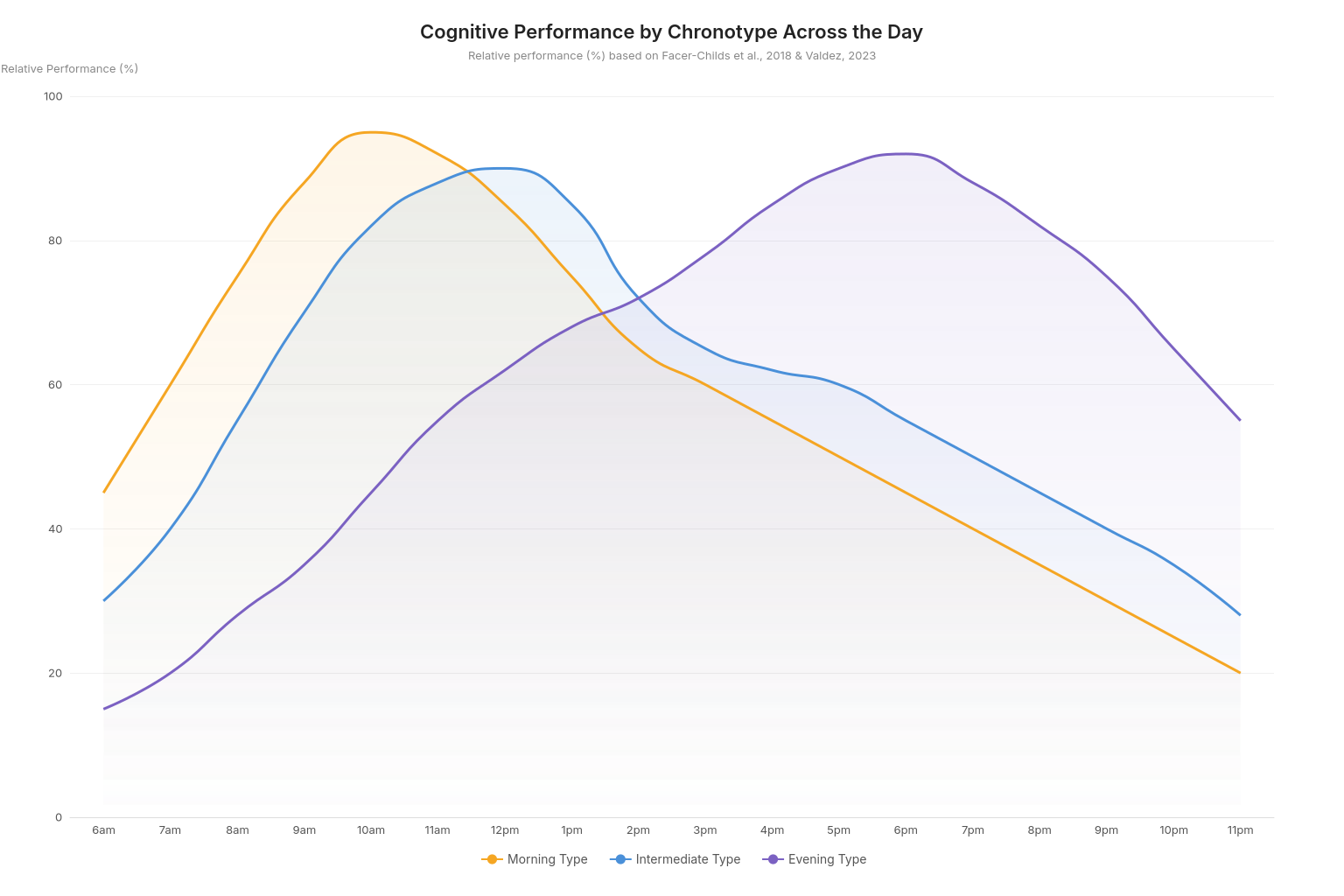
A 2023 systematic review analyzing 523 studies found significant diurnal variation in cognitive performance. Your brain's processing speed, working memory, and executive function fluctuate predictably throughout the day (4). These fluctuations aren't small. Depending on the task and your chronotype, performance differences between peak and trough can exceed 20%.
Time blocking works, but it works best when you align those blocks with your biological rhythms. A perfectly organized calendar filled with deep work sessions during your cognitive low point is organized failure.
The Four Energy Dimensions (and What's Changed Since 2007)
Schwartz and Loehr's original framework identified four energy dimensions: physical, emotional, mental, and spiritual (1). The model argued that managing all four (through specific rituals and recovery periods) mattered more than squeezing more tasks into available hours.
The broad framework still holds up. A 2000 study by Galinsky et al. found that adding rest breaks to workers' schedules improved both productivity and well-being (5). Perlow and Porter's research at Boston Consulting Group showed that predictable, required time off actually increased overall output (6). The idea that recovery fuels performance, rather than undermining it, is well-supported.
What hasn't aged well is the underlying mechanism that Schwartz and others implicitly relied on: ego depletion.
The Ego Depletion Problem
Roy Baumeister's ego depletion model, published in 1998, proposed that self-control works like a muscle. Use it, and it gets tired. The original studies suggested that performing one act of self-control (resisting cookies, suppressing emotions) impaired performance on a subsequent task. Some research even claimed that drinking glucose could restore depleted willpower.
The glucose hypothesis didn't survive replication. A 2014 study explicitly failed to reproduce the sugar-restores-willpower effect (7). But the problems went deeper than one failed experiment. A 2017 paper in Frontiers in Psychology argued that ego depletion faced conceptual problems, not just statistical ones. There was no clear operational definition of what "depletion" even meant or how to measure it (2). By 2025, Michael Inzlicht, one of the field's leading researchers, published "The Collapse of Ego Depletion," describing the effect as essentially unsupported (8).
This matters for energy management because it changes the mechanism. Your afternoon slump isn't because you "used up" your willpower at breakfast. It's because your brain's alertness, attention, and cognitive processing follow biological rhythms that have nothing to do with a willpower tank.
The good news: we now understand these rhythms much better than Schwartz did in 2007.
Your Biological Clock Is Your Productivity Clock
Your body runs on a roughly 24-hour circadian cycle governed by the suprachiasmatic nucleus in the hypothalamus. This cycle regulates far more than sleep. It controls core body temperature, hormone release, and critically, cognitive performance.
Chronotype: When Your Brain Peaks
Not everyone's clock runs on the same schedule. Your chronotype (whether you're a morning person, evening person, or somewhere in between) determines when your cognitive functions peak.
A 2023 study published in PMC found that chronotype is strongly related to cognitive functioning, with significantly better performance at the individual's preferred time of day (9). A 2018 study by Facer-Childs et al. went further, showing that both time of day and chronotype predict peak cognitive and physical performance in healthy volunteers (10).
Here's the practical problem: most work schedules are designed for morning chronotypes. Standard 9-to-5 hours favor people whose cognitive peak hits between 9am and noon. A 2025 study found that evening chronotypes experience the worst work ability and highest productivity loss, likely because their internal clocks are chronically misaligned with their schedules (11). A 2022 study confirmed that when people align their sleep schedules with their chronotype (earlier bedtimes for morning types, later wake-ups for evening types), work productivity improves (12).
Roughly 25-30% of the population leans toward eveningness. If you're one of them and you're scheduling your hardest work at 9am, you're fighting your biology.
Ultradian Rhythms: The 90-Minute Cycle
Beyond the 24-hour circadian cycle, there's evidence for shorter ultradian rhythms during waking hours. Sleep researcher Nathaniel Kleitman proposed the Basic Rest-Activity Cycle (BRAC): roughly 90-100 minute oscillations in alertness and cognitive capacity that continue throughout the day, not just during sleep.
A 1995 study documented these ultradian rhythms in task performance and EEG patterns, finding measurable fluctuations in how effectively people processed information across the day (13).
A caveat: the evidence for waking ultradian rhythms is moderate, not definitive. The 90-minute cycle is well-established in sleep research (it maps onto sleep stages), but its daytime manifestation is harder to pin down precisely. Individual variation is substantial. Some people notice clear 90-minute focus waves; others don't.
What the research does support clearly: sustained focus for more than 90-120 minutes yields diminishing returns for most people. Whether that's a strict biological rhythm or simply attentional fatigue, the practical advice is the same. Build in breaks.
How to Build an Energy-Aware Schedule
The research points to a clear protocol. Here's how to apply it.
Step 1: Track Your Energy for One Week
Before changing anything, measure what you have. Three times a day (morning, midday, late afternoon), rate your energy and focus on a simple 1-5 scale. Note what you were doing and how productive you felt.
After a week, patterns emerge. Most people discover they have a 2-4 hour peak performance window and a predictable trough (often early-to-mid afternoon, though evening types may experience a morning trough instead).
Step 2: Identify Your Peak Window
Your peak window is when deep, cognitively demanding work should happen. For most morning and intermediate chronotypes, this falls between roughly 9am and noon. For evening chronotypes, it may not arrive until late morning or early afternoon.
The 2023 systematic review found that these windows affect a wide range of cognitive functions: working memory, attention, executive function, and processing speed (4). During your peak, you're measurably faster, more accurate, and better at complex problem-solving.
Step 3: Protect Peak Hours for Deep Work
This is where energy management meets weekly planning. Block your peak window for tasks that require the most cognitive effort: writing, strategic thinking, complex analysis, creative work.
Move shallow work (emails, administrative tasks, routine meetings) to your trough periods. These tasks don't require peak cognitive function, and doing them during low-energy hours means you're not wasting your best brain time on autopilot work.
Step 4: Build in Recovery
The research on rest and breaks is consistent: they help. Galinsky et al. found that added rest breaks improved productivity and well-being (5). Berkeley's Greater Good Science Center reported that breaks improve creative performance, especially when people expect to return to the task afterward (14).
A practical rhythm: 90-120 minutes of focused work, followed by 15-20 minutes of genuine rest. Not scrolling social media. Actual recovery. Walk, stretch, eat something, look out a window. The break is part of the productive cycle, not a departure from it.
Step 5: Align Your Calendar to Your Biology
This is the step most people skip. You know your peak window, you know you need breaks, but your calendar still schedules a standup meeting at 9:30am and a "quick sync" at 2pm. The schedule wins, and biology loses.
The fix requires treating your peak energy window with the same respect as a meeting with your boss: it's a commitment, not a suggestion. Schedule it. Defend it. Make it visible on your calendar so others know when you're unavailable.
| Time Block | Energy Level | Best For |
|---|---|---|
| Peak window (2-4 hrs) | 🟢 High | Deep work: writing, strategy, complex problems |
| Transition (1-2 hrs) | 🟡 Medium | Collaborative work: meetings, brainstorming |
| Trough (1-2 hrs) | 🔴 Low | Shallow work: email, admin, routine tasks |
| Recovery (15-20 min) | ⚪ Rest | Walk, stretch, snack (not screens) |
The Technology Gap
Here's the disconnect: every calendar app on the market treats every hour as equal. 9am and 3pm get the same blank rectangle. There's no concept of energy state, cognitive capacity, or chronotype. You can block time, but the tool doesn't know or care whether you're scheduling deep work during your peak or your trough.
This is starting to change. A new category of tools is emerging that factor energy and biological rhythms into scheduling decisions. Exoplan, for example, uses energy-aware scheduling to predict when you'll be at your best and suggests task placement accordingly. Instead of you manually tracking your energy and protecting your calendar, the tool does the alignment for you.
This isn't a luxury feature. If cognitive performance really varies by 20%+ across the day based on circadian timing (and the research says it does), then scheduling without energy awareness means you're leaving a significant chunk of your potential output on the table. Every day.
What the Critics Get Wrong
"This is just self-care rebranded." It isn't. Self-care is about wellness. Energy management is about strategic allocation of a variable cognitive resource. The research on circadian performance variation isn't wellness advice. It's performance science backed by circadian biology.
"Not everyone has schedule flexibility." True. Shift workers, hourly employees, and parents with rigid childcare schedules can't always choose when they do deep work. But even within constraints, the framework scales: knowing your trough lets you lower expectations during that window rather than beating yourself up for underperforming. And small changes, like saving your hardest task for your first 90 minutes rather than starting with email, are available to almost everyone.
FAQ
How do you manage your energy, not your time?
Track your energy levels for a week to identify your peak performance window (typically 2-4 hours). Schedule your hardest, most cognitively demanding work during that window. Move shallow tasks like email and admin to your low-energy periods. Build 15-20 minute rest breaks between 90-minute work blocks.
What is the difference between time management and energy management?
Time management treats every hour as equal and focuses on fitting more tasks into available slots. Energy management recognizes that cognitive performance varies significantly throughout the day based on circadian rhythms and chronotype (9). It focuses on matching task difficulty to energy level, rather than simply filling time.
What does "manage your energy" mean?
It means treating your cognitive and physical energy as a variable resource that fluctuates predictably and can be optimized. The concept, popularized by Tony Schwartz in the Harvard Business Review (1), argues that managing energy across physical, emotional, mental, and biological dimensions produces better results than managing time alone.
Do ultradian rhythms really affect productivity?
There's moderate evidence for roughly 90-minute cycles of alertness during waking hours, based on Kleitman's Basic Rest-Activity Cycle (13). The evidence is stronger for sleep stages than for daytime productivity, but most research supports the practical conclusion: sustained focus beyond 90-120 minutes shows diminishing returns, and strategic breaks improve output (5).
The Bottom Line
Schwartz was right in 2007: energy matters more than time. But the science has moved on. We don't need to talk about willpower tanks or glucose restoration anymore. Circadian biology, chronotype research, and ultradian rhythm studies give us a much clearer (and more honest) picture of how cognitive performance actually works.
Start with one change: find your peak window and protect it. That 2-4 hour block where your brain is running at full capacity is the single most valuable resource in your day. Stop filling it with email.
Exoplan helps you build an energy-aware schedule by predicting your peak performance windows and aligning your tasks to your biology. Try it free on iPhone and Apple Watch.
References
- Schwartz, T. & McCarthy, C. "Manage Your Energy, Not Your Time." Harvard Business Review, Oct 2007. hbr.org
- Lurquin, J.H. & Miyake, A. "Challenges to Ego-Depletion Research Go Beyond the Replication Crisis." Frontiers in Psychology, 8:568, 2017. frontiersin.org
- Drucker, P.F. The Effective Executive. Harper & Row, 1967.
- Valdez, P. "Diurnal variation in variables related to cognitive performance: A systematic review." Sleep and Breathing, 2023. springer.com
- Galinsky, T.L. et al. "Impact of added rest breaks on the productivity and well-being of workers." Ergonomics, 43(6), 768-778, 2000. researchgate.net
- Perlow, L.A. & Porter, J.L. "Making Time Off Predictable—and Required." Harvard Business Review, Oct 2009.
- Lange, F. & Eggert, F. "Unsuccessful attempts to replicate effects of self control operations and glucose on executive functions." PLOS ONE, 2014. pubmed.ncbi.nlm.nih.gov
- Inzlicht, M. "The Collapse of Ego Depletion." Speak and Regret, 2025. speakandregret.com
- "Time of day and chronotype in the assessment of cognitive functions." PMC, 2023. pmc.ncbi.nlm.nih.gov
- Facer-Childs, E.R. et al. "The effects of time of day and chronotype on cognitive and physical performance in healthy volunteers." Sports Medicine - Open, 4:47, 2018. springer.com
- "Work ability and health-related productivity loss by chronotype." PubMed, 2025. pubmed.ncbi.nlm.nih.gov
- "On workdays, earlier sleep for morningness and later wakeup for eveningness improve work productivity." PubMed, 2022. pubmed.ncbi.nlm.nih.gov
- "Ultradian rhythms in task performance, self-evaluation, and EEG." PubMed, PMID: 7870505, 1995. pubmed.ncbi.nlm.nih.gov
- "How Resting More Can Boost Your Productivity." Greater Good Science Center, UC Berkeley. greatergood.berkeley.edu